

To get your child off the Xbox, or any games console, without a meltdown, agree the limits with them beforehand, give a warning before the end, and stop at a natural break such as the end of a match, not in the middle of one. Then do the same thing every time. Most rows come from surprise and inconsistency, not from the rule itself.
This guide pulls together what child psychiatrists suggest, what the surveys say about how common these arguments are, and how TV Parent can help you on the TV side. We are not against gaming. For many young people it is where their friends are.
You are not the only one
If switching off often ends in a row, you are in the majority.
- In a ConsumerAffairs survey, 70% of parents said they argue about screens at least weekly.
- In Talker Research's survey of 2,000 parents, parents gave in about 65% of the time when a child pushed back.
- Lurie Children's Hospital reports that 60% of parents feel guilty about their child's screen time.
So the aim is not a perfect household. It is a setup where the rule is clear, the cut-off is fair, and you are not the one pulling the plug every night.
What experts suggest
Advice from child psychiatrists at Mayo Clinic, Stanford and UCLA is fairly consistent:
- Agree the limits with your child. For example, sessions of one to two hours with breaks. A rule they helped to write is easier to keep.
- Be consistent. Treat gaming time as a privilege that depends on meeting family expectations, such as homework and chores, and enforce it in the same way each time.
- Stop an hour or two before bed. The psychiatrists advise ending gaming one to two hours before bedtime.
- Keep consoles out of the bedroom at night if you can. One psychiatrist says gadgets in the room increase use by about 50%.
- Ask why they game. It can be fun, but sometimes it hides worry, loneliness or school stress. Banning it outright can cut a child off from their main group of friends.
- Play with them, and set an example. Show an interest and be honest about your own screen habits.
- Remember that children underestimate. Stanford notes that parent and teen accounts of gaming time are often wildly mismatched.
- Get help if it is hurting sleep, mood, school or relationships. Speak to your GP or your child's school.
How to end a session without a meltdown
Here is a simple pattern that many families use:
- Agree the finish time in advance. "Off at 8.30" is better than a surprise.
- Warn them. A warning with ten minutes and five minutes to go gives them time to finish what they are doing.
- End at a natural break. Online games have no pause button. "I can't stop mid-match" is a real problem, so let the match finish where you can. Plan the warning so a match fits.
- Keep your voice calm. Stay friendly and short. Do not reopen the negotiation.
- Offer something next. A snack, a chat or a walk is easier to move to than "nothing".
- Praise the good ends. Notice when they switch off on time.
If you want more on what is normal at different ages, see our guide to how much screen time is normal by age. For bedtime, see stopping kids watching TV at night.
Console settings and TV settings are different things
The main console makers, such as Xbox, PlayStation and Nintendo, have their own family settings, including play-time limits, purchase controls and chat settings. These are the right place to set time limits for the console itself. Check each maker's own help pages for the current steps, as they change.
The TV is a second layer. A console shows its picture on the TV through an HDMI input, so controlling the TV's input is one more way to say "not now".
How TV Parent helps
TV Parent is an Android app for LG smart TVs, coming soon to Google Play. Your phone and the TV need to be on the same home Wi-Fi, and it works with LG webOS TVs only. For gaming, it can:
- Send a message to the TV, such as "5 minutes left". You type and send it yourself, so it is not an automatic countdown.
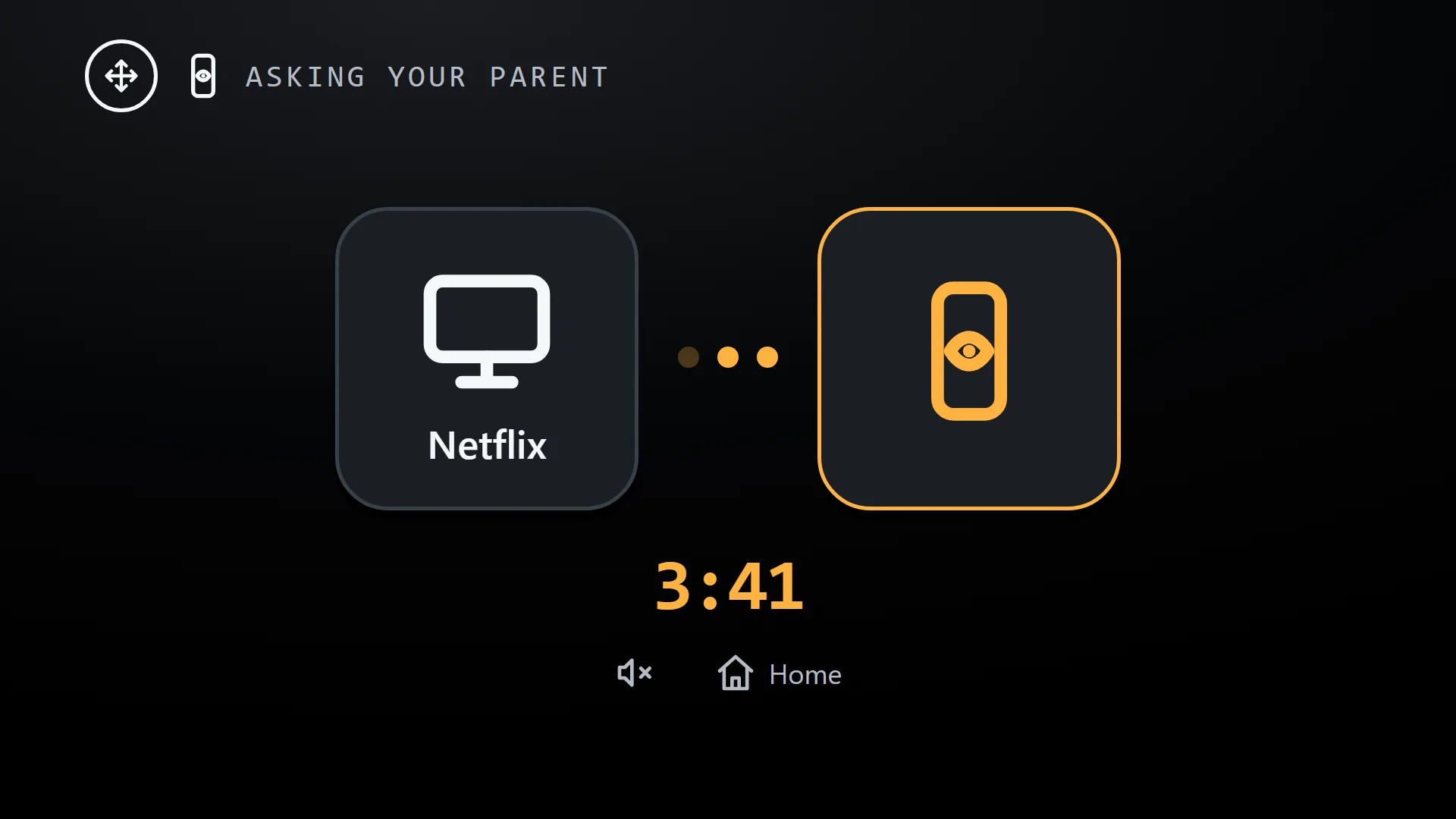
- Set the console's HDMI input to ask first or to be blocked. Your child asks, you decide on your phone, and you are not the one standing in the doorway.
- Lock the TV at the agreed time, with a message on screen. It is the phone doing it, not you.
- Use a schedule, so different times apply on school nights and weekends.
- Hold the volume at a level, so a loud game does not carry through the house (a Pro feature).
The honest limit: TV Parent controls the TV and its inputs, not the console itself. It cannot set time limits inside Xbox, PlayStation or Switch. A handheld, or a console with its own screen, is not covered at all. Neither are phones, tablets and laptops. Free covers messages and locking. Pro (£9.99, paid once) adds more. Plus is £2.99 a month or £24.99 a year, with 7 days free. See the pricing.
Common questions
How do I get my child off the Xbox without a meltdown?
Agree the end time before they start, warn them ten and five minutes before, and stop at the end of a match. Stay calm and do the same each time, because experts stress consistency.
What are sensible Xbox time limits for a 14-year-old?
There is no single right number. Psychiatrists suggest agreeing limits with your teen, for example sessions of one to two hours with breaks, and no gaming for one to two hours before bed. Adjust for homework, sleep and how your child is doing.
Is my child addicted to gaming?
Loving games is not the same thing. The World Health Organization recognises gaming disorder, whose core signs are loss of control, gaming taking priority over everything else and carrying on despite harm. Estimates for teenagers range from about 2 to 3% under strict criteria to 8.6% in one large 2024 review. If gaming is clearly hurting sleep, mood, school or relationships, ask a professional for help.
Why does my child get so angry when I tell them to stop?
Often it is the sudden stop in the middle of something that matters to them, such as a match with friends. A warning and a natural finishing point help a lot.
Sources
- ConsumerAffairs: screen time arguments
- Talker Research: how long parents spend fighting over screen time
- Lurie Children's: screen time 2025
- Mayo Clinic news network
- Stanford Medicine: teen video game addiction, five things to know
- UCLA Health: managing teen tech use
- Mumsnet thread: Xbox time limits for a 14-year-old
- Frontiers in Psychiatry on gaming disorder