

Should my child have a TV in their bedroom? There is no single right answer, but the evidence leans towards "not yet, or not without rules". Health bodies mostly advise keeping screens out of bedrooms, especially at night. If you do say yes, it goes much better when you agree the rules first and keep a way to stay in charge.
You are not alone in wondering. In one TV retailer's survey, 75% of parents said their child had asked for a TV in their room. This guide gives you what doctors and studies say, a plain answer on age, and a checklist you can use whichever way you decide.
What the experts say
The advice is not all one-sided, so here is the fair version.
- American Academy of Pediatrics (AAP): its long-standing advice is to keep the TV, and any internet-connected device, out of a child's bedroom. It links bedroom TVs to higher risks of obesity and to exposure to unsuitable content, and says screens behind a closed door are hard for parents to keep an eye on. Much of the coverage we read dates from 2007 to 2016, so check the AAP's parent site, HealthyChildren.org, for its current wording.
- Royal College of Paediatrics and Child Health (RCPCH, UK): in 2019 it said there should be no screens for an hour before bed. It also said the evidence that screen time is harmful in itself is weak, so it set no fixed daily limit. The worry is what screens push out: sleep, exercise and family time.
- Child psychiatrists (including Mayo Clinic, Stanford and UCLA) suggest keeping consoles and gaming laptops out of the bedroom at night, stopping 1 to 2 hours before bed, and agreeing limits with your child and then sticking to them.
What the studies found
Most research here shows a link, not proof of cause. Even so, the pattern is consistent.
| Topic | What was found |
|---|---|
| Sleep | A study in Pediatrics of 2,048 children aged 9 to 13 linked a bedroom TV to 18 fewer minutes of sleep a night |
| Weight | A University of Alberta study (2012) found children with one or more devices in the bedroom were far more likely to be overweight |
| School | An Iowa State study (2017), following children for one to two years, linked bedroom media to more total screen time and worse school performance |
The Iowa State researchers did not blame the TV itself. The problem is what it replaces: reading, sleep and homework. And a bedroom TV is a closed-door TV. Ofcom's research found that family viewing is social, while bedroom viewing tends to be solitary, with children saying they watch one video after another and "stay up half the night".
What age?
If you are asking "what age should a child have a TV in their room?", the honest answer is that no medical body gives a number. The RCPCH sets no age, and the AAP's advice is to keep TVs out of bedrooms at any age.
Parents on forums such as Mumsnet give a huge range of answers, from "12, for DVDs and an Xbox" to "never". "Not before secondary school" comes up a lot. That is not a rule, just what many families settle on.
So instead of an age, ask about your child:
- Do they go to sleep on time and wake up without a battle?
- Do they stop when asked, or is every switch-off a row?
- Is homework done without the TV or console being the distraction?
- Can they cope with being trusted to turn it off themselves?
- Would a shared room, such as the living room, give them most of what they want?
If most answers are "yes", a bedroom TV with clear rules can work. If not, waiting a year and trying again is a perfectly reasonable decision. For children under 2, the AAP advises avoiding screens altogether.
Rules to agree before the TV goes in
Agree these with your child before the TV arrives, and write them down. Rules agreed in advance cause far fewer arguments than rules invented in the middle of a row.
- A bedtime for the screen. Off at least an hour before sleep, in line with the RCPCH. The TV goes off at a set time, whatever is on.
- Homework first. No TV until it is done, and no TV on in the background while they do it.
- Which apps and channels are allowed. Agree what is fine, and what needs asking first.
- Ask first for the console. Consoles run for hours and a "last match" is rarely the last. Agree set sessions with breaks.
- No TV behind a closed door at night. Night-time viewing is where the sleep problems start.
- Weekends can differ. Many families choose later times on Friday and Saturday, with the same rules otherwise.
- You can check in. Say plainly that you may look at what is on, and why.
- No falling asleep with the TV on. See our guide on whether it is bad if a child falls asleep with the TV on.
The psychiatrists' point is worth repeating: treat screen time as a privilege that depends on the family's expectations being met, and enforce it consistently. Consistency matters more than strictness.
If you decide yes: keeping control without the arguments
Rules only work if something makes them stick. Parents say the hardest part is the moment of switching off, and that they end up as "the bad guy". Anything that makes the cut-off happen on its own, rather than by you marching upstairs, helps.
LG's own Family Settings (on newer LG TVs, webOS 22 and later) can set a viewing time window, a volume limit and a usage report, all set up on the TV. If you do not yet own the TV, our guide to buying a TV for a child's bedroom lists what to check. And if you are choosing sensible limits, see how much screen time is normal by age.
How TV Parent helps
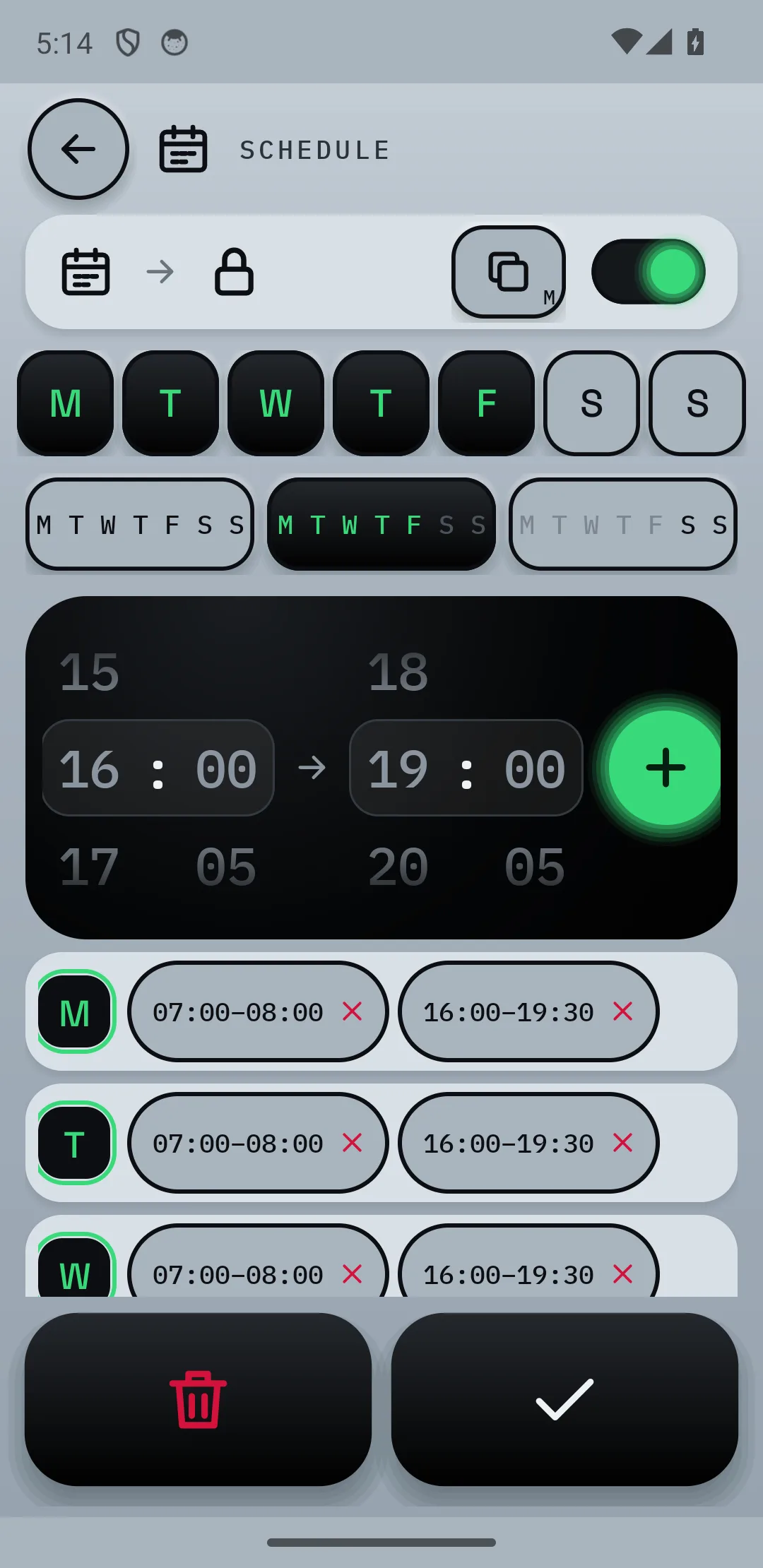
TV Parent is an Android app for LG webOS TVs, coming soon to Google Play. It runs on your phone over your home Wi-Fi, so you manage the TV without going upstairs.
- Lock the TV with a full-screen message such as "Homework time", and unlock it with your PIN.
- Put bedtime on a schedule, with different times for school nights and weekends.
- Let your child ask first when they want more time, so you decide from your phone.
- Send a quick message to the TV such as "5 minutes left" before cut-off.
- See what is on, with a screenshot, which app is playing and how long the TV has been on.
It has limits. It works with LG webOS TVs only, on Android phones, and the phone and TV must be on the same home Wi-Fi (it does not work when you are out yet). It cannot stop phones, tablets or laptops, and it cannot control a console itself, only the TV's HDMI input, which you can set to ask first or block. Prices are in the pricing section: Free, Pro at £9.99 once, or Plus at £2.99 a month or £24.99 a year, with 7 days of Plus free.
Common questions
Is it OK for a 10-year-old to have a TV in their bedroom?
There is no official age, so it depends on the child and on the rules. Many parents wait until secondary school. At 10, the safer choices are a shared room for screens, or a bedroom TV that is switched off an hour before bed and cannot be turned on again overnight.
Is a TV or a games console in the bedroom worse?
Experts tend to treat both the same: they add up to more screen time and hide it behind a closed door. Consoles bring extra worries, such as long sessions, online chat and the difficulty of stopping mid-game. Psychiatrists suggest keeping them out of the bedroom at night.
Can I take the TV out later if it does not work?
Yes, and plenty of parents do. One parent on a forum said removing the bedroom TV "ended the arguments". Tell your child at the start that the TV stays only while the rules are kept. That makes taking it away fair rather than a surprise.
Will no screens at all make my child feel left out?
Not usually. The RCPCH did not set a daily time limit, because the harm comes from what screens replace. Time with friends and family viewing in a shared room still counts. The aim is balance, not a ban.
Sources
- Reliant survey on children asking for a bedroom TV
- NBC News on American Academy of Pediatrics guidance
- Irish Times on RCPCH screen guidance
- PsyPost on the Pediatrics study of bedroom TVs, sleep and weight
- ScienceDaily on the University of Alberta study
- UPI on the Iowa State study
- Mayo Clinic on managing gaming
- Mumsnet thread: TVs in bedrooms, what age
- Ofcom Children's Media Lives
- LG Family Settings help page