

Is it bad for my child to fall asleep with the TV on? Occasionally, it will not do harm. As a nightly habit, the research suggests it is best avoided, because screens near bedtime are linked to less sleep and a TV left running can disturb the sleep they do get. The good news is that you do not need a battle to fix it.
You are far from the only parent dealing with this. In a TV retailer's survey, 45% of parents said their child uses the TV to fall asleep. This guide explains what the evidence says, why children do it, and practical ways to make sure the TV is off once they drift away.
Why children fall asleep with the TV on
It is easy to see why it happens. The TV is comforting background noise. It stops a quiet room feeling lonely or dark, and a familiar show can feel like a bedtime routine. Ofcom's research on children's media habits found that children say they watch videos to fall asleep, and that one video easily leads to another.
None of this makes your child "naughty", and it is not a sign you have failed. It is a habit, and habits can be changed gently.
What the research says
Be wary of anyone who says this is simple. Most studies show a link, not proof of cause. Here is what the named sources say.
- Royal College of Paediatrics and Child Health (RCPCH, 2019): recommends no screens for an hour before bed. It says screens stimulate the brain, and that the blue light they give off can disrupt melatonin, the hormone that helps us sleep. It found no evidence that "night mode" makes screen use before bed fine.
- A study in Pediatrics of 2,048 children aged 9 to 13: a TV in the bedroom was linked to 18 fewer minutes of sleep a night. A phone or other small screen was linked to about 21 fewer minutes.
- Child psychiatrists (including Mayo Clinic, Stanford and UCLA) suggest stopping screens 1 to 2 hours before bed and keeping devices out of the bedroom at night.
The RCPCH was also clear that it set no fixed daily limit, as the evidence that screen time is harmful in itself is weak. The problem it points to is what screens push out of the day, and a bedtime TV pushes out sleep.
Is the TV helping them wind down?
Many parents feel it does, and a calm, familiar show may feel relaxing to the child. But the RCPCH's advice is that screens stimulate the brain, so a screen is not the same as winding down. A better wind-down is something with no screen: a bath, a story, quiet music or an audiobook.
What to do instead
Take it step by step, and be kind about it. Taking away a comforting habit with no replacement is what causes rows.
- Pick a screen-off time. Aim for at least an hour before sleep, as the RCPCH suggests. Tell your child the new rule in daylight, not at bedtime.
- Build a new routine. Bath, teeth, a story or an audiobook, then lights out. Repeat it in the same order every night.
- Replace the noise if they need it. A quiet audio story, soft music or a white-noise sound can give the comfort without the picture.
- Be consistent. Psychiatrists stress agreeing limits with your child and then enforcing them every time.
- Expect a few rough nights. Staying calm and consistent helps most.
If sleep is a bigger problem than a habit, such as constant tiredness, low mood or trouble at school, speak to your GP or health visitor. We cannot give medical advice, and this guide does not replace it.
Switching the TV off after they fall asleep
Even with a good routine, some nights the TV is still on when your child nods off. Here are practical options, from simplest to most automatic.
| Option | How it works | Catch |
|---|---|---|
| Sleep timer on the TV | Turns the TV off after a set time | It may need setting each night, and a child may be able to change it |
| LG Family Settings | On newer LG TVs (webOS 22 and later), a viewing time window needs a password outside it | Set up on the TV itself, so you change it there |
| Smart plug on a schedule | Cuts the power at a set time | One parent called a scheduled plug "generally drama-free", and it needs no setting on the TV |
| Wi-Fi off at night | The most common fix on parent forums | Only helps with online apps, and will not stop a phone hotspot |
| A phone app | Schedule or lock the TV from your phone | Needs an app that supports your TV |
Our guides on stopping kids watching TV at night and on using a smart plug or Wi-Fi switch-off at bedtime go through the home-made fixes in more detail. Whatever you use, the key is that the cut-off should happen on its own, so you are not the one walking in and switching off.
A word on safety: use a smart plug that suits the TV and follow the maker's instructions, and do not leave anything plugged into a tangle of extension leads.
How TV Parent helps
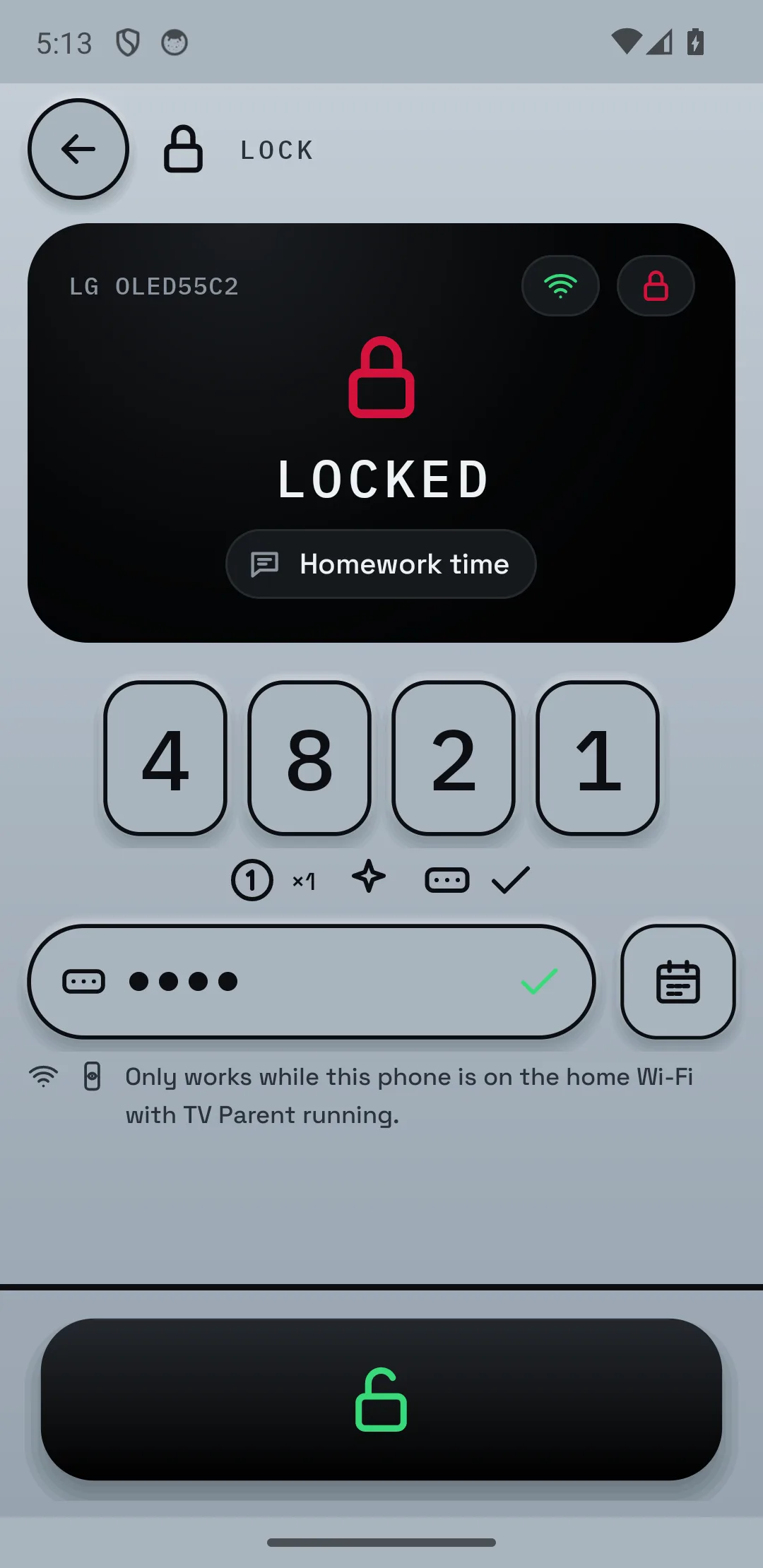
TV Parent is an Android app for LG webOS TVs, coming soon to Google Play. It runs on your phone over your home Wi-Fi.
- Set bedtime on a schedule, with different times for school nights and weekends.
- Lock the TV with a full-screen message, and unlock it with your PIN. You can set it so the lock returns after the TV is switched on again.
- Send a message to the TV such as "5 minutes left" before the cut-off, so it is less of a shock.
- Hold the volume at a level so a late-night show stays quiet.
- See what is on and how long the TV was on, so you know what really happened.
It has limits. It works with LG webOS TVs only, on Android phones, and the phone and TV must be on the same home Wi-Fi (it does not work when you are out yet). It cannot stop phones, tablets or laptops, and it cannot control a console itself, only the TV's HDMI input, which you can set to ask first or block. Prices are in the pricing section: Free, Pro at £9.99 once, or Plus at £2.99 a month or £24.99 a year, with 7 days of Plus free. The lock-returns feature is part of Pro.
Common questions
Is it OK for my child to fall asleep with the TV on sometimes?
Yes. An occasional night, such as a sick day or a holiday, is not a problem. The concern is the nightly habit, because the research links bedroom TVs and screens near bedtime to less sleep.
Is it OK for a toddler to fall asleep with the TV on?
For young children, health bodies are stricter. The American Academy of Pediatrics advises avoiding screens altogether for under-2s. For toddlers, replace the TV with a bedtime story or soft audio, and ask your health visitor if you need support.
Does the TV light or noise wake my child up in the night?
It can. The RCPCH says screens stimulate the brain and the light can disrupt melatonin, and a TV that stays on can bring sound and light through the night. Turning it off after they fall asleep, or using a timer, avoids this.
How can I stop my teenager watching TV in bed until late?
Agree a cut-off time with them, rather than imposing it, and make it automatic with a schedule so it is not a nightly argument. Psychiatrists also suggest keeping gaming out of the bedroom at night.
Sources
- Reliant survey on children's bedroom TVs
- Irish Times on RCPCH screen guidance
- RTE on RCPCH screen guidance
- PsyPost on the Pediatrics study of bedroom TVs and sleep
- Ofcom Children's Media Lives
- Mayo Clinic on managing gaming
- Common Sense Media on a good night's sleep
- Reviewed on a smart plug for bedtime
- LG Family Settings help page
- NBC News on American Academy of Pediatrics guidance